
Stelemind · Blog
AI Maturity Model: 4 Stages From Prompts to Loops
By Marko6 min read
Everyone on your team already uses AI, yet the work looks exactly like it did a year ago. Sound familiar? A corporate AI maturity model will not help much here: it was written for companies with a chief data officer and a transformation budget. A team of 15 needs a simpler question answered. What actually changes in daily work when AI becomes part of it, not just another browser tab?
Below are four stages, the signs of each, and a short test to find your own.
What is an AI maturity model?
An AI maturity model describes how deeply AI is built into the way a company works: from one-off requests by individual people to processes that run on their own. It shows where you are now and what the next step is. A useful model measures how daily work has changed, not how many tools you pay for.
There are plenty of these models. According to an overview by The Decision Lab, they range from 4 to 7 stages. The best known ones, Gartner's among them, assess strategy, data, risk governance and culture. For a large company those are the right questions. For a studio with 15 developers they sound abstract: there is no AI strategy, there are people doing things with AI every day.
So we look at something else: what an ordinary working day looks like, and where AI sits in it.
What are the 4 stages of AI maturity?
The four stages of AI maturity are Prompt, Context, Harness and Loop. At the first, people write requests from scratch. At the second, AI knows the business context. At the third, it works inside the process with checked results. At the fourth, routine work runs in cycles and people make the decisions. Each stage rests on the one before.
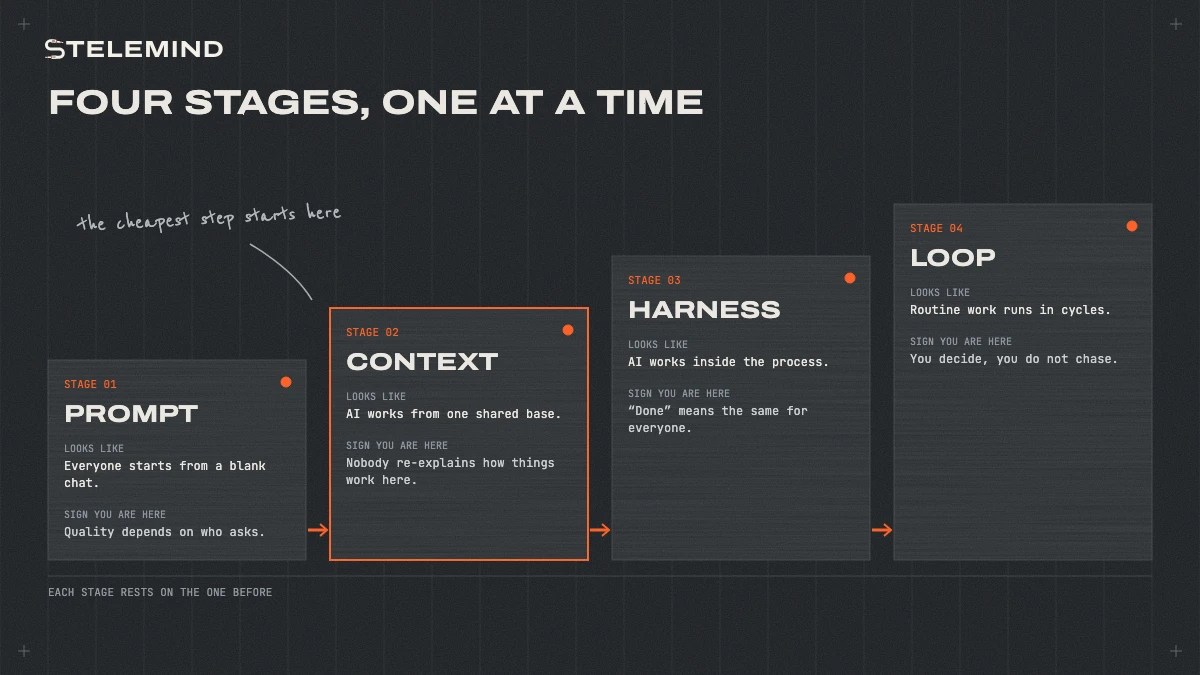
The names come from engineering, where they describe how work with language models has evolved. We apply them to the business as a whole: not "how an engineer codes with AI" but "how a team works with AI".
Stage 1. Prompt: everyone on their own
What it looks like. People open an AI chat and write a request from scratch every time. Some get great results, others give up after two tries.
The sign. Quality depends on who is asking. Two managers with the same task get completely different answers.
The limit. AI knows nothing about your business. Every request starts with explaining who you are and what you do, or skips it and gets a generic answer.
What the next stage gives you. Shared rules and request templates, so the result no longer depends on the person.
Stage 2. Context: AI knows your business
What it looks like. The team has one knowledge base: decisions, agreements, process descriptions, project history. AI works from it instead of a blank page.
The sign. A new person or a new chat does not need the context retold. The answer to "how do we do this here" is in the base.
The limit. AI helps more, but nobody checks the result systematically yet. A person decides by eye whether the work is done.
What the next stage gives you. Work with a clear definition of "done" that gets checked before it is accepted.
Stage 3. Harness: AI inside the process
What it looks like. Tasks live in a task manager with acceptance criteria. AI does its part of the work with access to the tools it needs, and the result is checked against those criteria.
The sign. "Done" means the same thing for everyone. When work goes back for rework, the reason is written down in words, not "something is off".
The limit. The process still depends on people remembering it: someone has to start things, send reminders, check that nothing got stuck.
What the next stage gives you. Routine work that runs without manual reminders.
Stage 4. Loop: processes run in cycles
What it looks like. Recurring tasks start on their own, stuck work gets noticed on its own, and a person only gets a question when their decision is needed.
The sign. The manager spends time on decisions, not on chasing. A week of vacation does not stop the work.
The limit. This stage needs the three before it. A loop without a knowledge base and without result checks only makes mistakes faster.
What comes next. Room for agents and automations that plug into a system that already works.
How do you assess your AI maturity?
Assess your AI maturity with eight questions, two per stage. Answer an honest yes or no about an ordinary working week, not your best one. Your stage is where the first "no" appears. The test takes two minutes and needs no tools, only an honest look at last week.
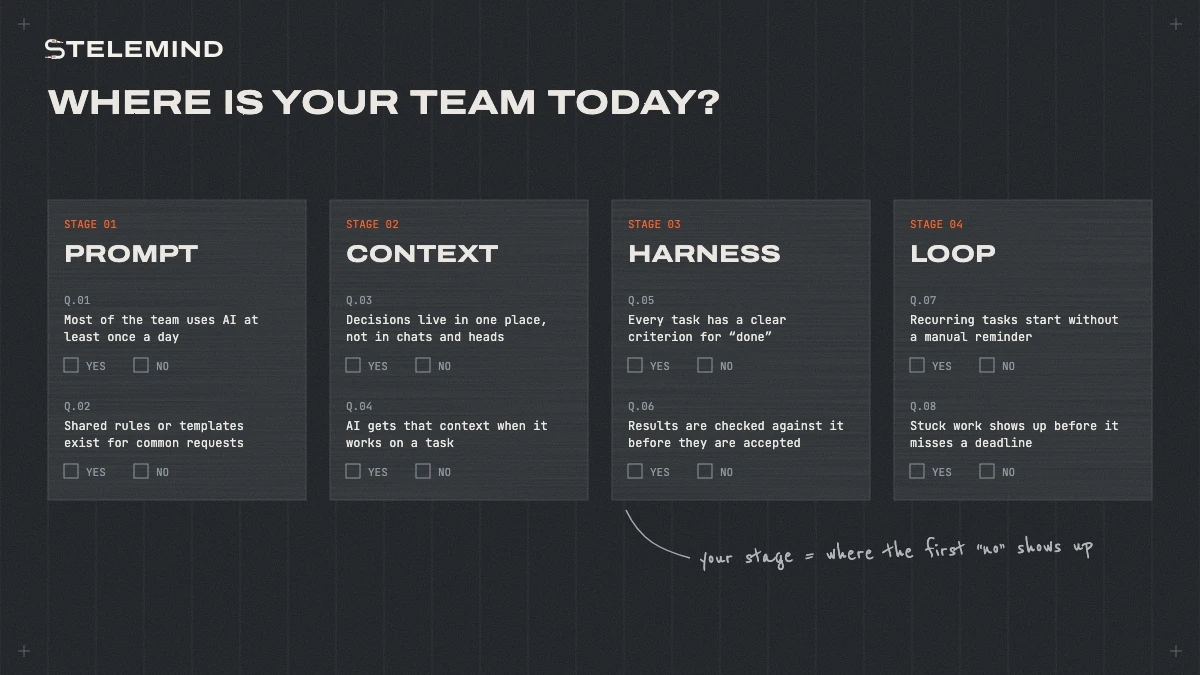
Stage 1. Prompt
- Does most of the team use AI at least once a day?
- Are there shared rules or templates for common requests?
Stage 2. Context
- Are decisions and agreements written down in one place, not scattered across chats and heads?
- Does AI get that context when it works on a task?
Stage 3. Harness
- Does every task have a criterion that shows it is done?
- Is the result checked against that criterion before it is accepted?
Stage 4. Loop
- Do recurring tasks start without a manual reminder?
- Do you learn about stuck work before it misses a deadline?
Can you skip a stage of AI maturity?
You cannot skip a stage of AI maturity: each one stands on the one before. Agents without a knowledge base work blind, and loops without result checks only multiply mistakes faster. You can move through the stages faster than large companies do, but you cannot leave any of them out.
The temptation is easy to understand. Most of the news is about agents, and it seems that plugging one in will make the work run itself. In practice, an agent at stage one is just another employee who knows nothing about the company and whom nobody checks. Our view: money put into agents before there is a base and a way to check results mostly burns.
Where should a small team start?
Start with the move from stage one to stage two: gather your business context into one base that both people and AI work from. It is the cheapest step, and every later stage stands on it. Tools can be swapped, but the decisions and agreements you collect stay with you for years.
In practice that means three things:
- write down the decisions that now live in chats and in the manager's head;
- agree that new information goes into the base, not only into messages;
- teach the team to work with AI so that it takes its context from there.
The last one is the hardest. A base is easy to build and just as easy to abandon if the team never gets used to it.
Summary
For a small team, an AI maturity model comes down to one question: where does AI sit in your ordinary working day? Prompt, Context, Harness and Loop come in order, and none can be skipped. If your team is at stage one, the best next step is not a new tool but a shared knowledge base.
We run our own work on a system that went through these four stages, and we build the same for other companies, around their processes. If you want to see what stages 3 and 4 look like in a live system, we will show you in a 20-minute call.