
Case study · By Stelemind team · 4 min read
AI Implementation Case Study: ADvantage Agency
Client
Marketing agency with several business lines and its own online products
Test group: five roles, from the CEO to a developer
- 9 of 10 → 1 of 3
- one-off manual actions among the COO's tasks, before the system → with the system
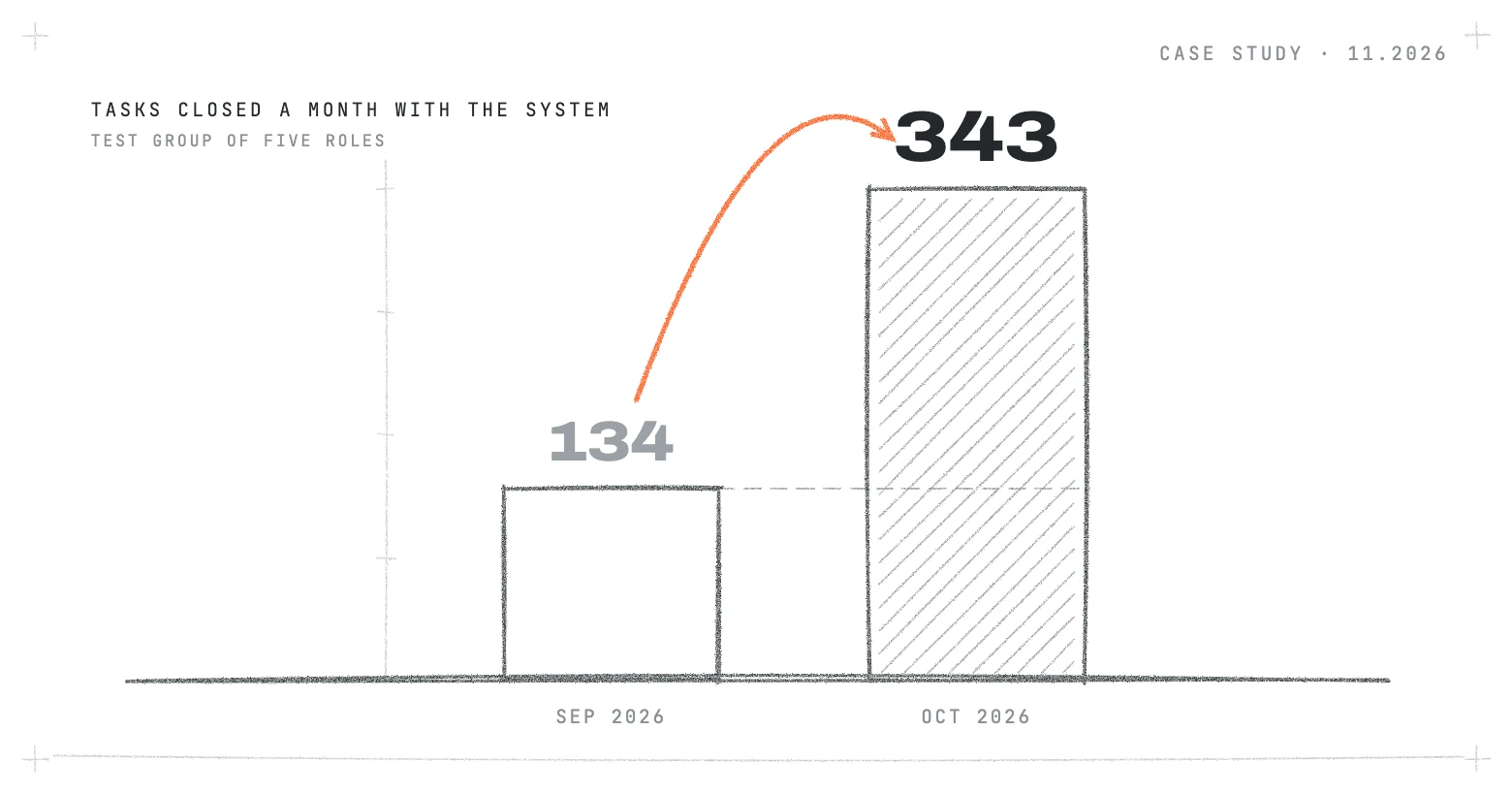
- 134 → 343
- tasks the test group closed a month while working with the system, September → October 2026
- 2 days
- to bring everything the agency's clients use into a new language
ADvantage is a marketing agency with several business lines and its own online products for clients. Its leaders wanted the work to stop depending on what each of them remembered. Here is what changed after they started working with Stelemind, what the numbers show, and where the system did not help.
Who tested the system
The first to adopt the system was a group of five roles that drive most of the agency's processes and directions: the CEO, the COO, the lead developer, a project manager and a developer. The rest of the team is now bringing the system into their own processes.
The numbers below cover this group only.
What was hurting
- Key knowledge lived in people's heads. Context sat in a few people's memory and in old chat threads.
- Everyone used AI on their own. Separate chats, separate habits. The AI started from zero every time and did not know the business.
- Routine ate the manager's day. About 9 of 10 tasks the COO closed were one-off manual actions: a call, a payment, a setting, a report.
- New directions meant contractors. Anything outside the usual work had to be ordered from outside.
"The hardest part was how much I had to keep in my head."
What changed in the working day?
The group stopped asking AI for help task by task and started working through a shared system. Knowledge moved from heads into one base that people and AI both use. Every task has a clear definition of done, and results are checked against it. Recurring work runs on schedule.
In terms of our four stages of AI in business, ADvantage went through every stage, from writing prompts by hand to Loop: recurring processes run on their own, and people make the decisions. Some work the agency used to order from contractors is now done by the system, under the group's control.
In October one developer left the group. The work did not slow down: the knowledge stayed in the system, and nobody had to rebuild it.
"I felt that a new reality had arrived. If you don't build context, your everyday work with AI stays a level lower."
The numbers: before and after
| What we measured | Before the system | With the system |
|---|---|---|
| Tasks closed by the COO per month | 84 to 150 | 208 in October 2026 |
| Share of one-off manual actions in the COO's tasks | about 9 of 10 | about 1 of 3 |
| Active processes and directions on the shared roadmap | 26 |
The "before" column covers only the COO: the agency kept no comparable records for the rest of the group before the system.
The group's pace also grew while working with the system. In September 2026 it closed 134 tasks, in October 343, as more knowledge and standards piled up in the shared base.
A task count is a rough measure: a big task and a small one count the same. That is why we also look at the type of work: the manager does less by hand and decides more.
How fast can a new direction launch?
ADvantage decided to reach a Chinese-speaking audience. Everything its clients use had to work in Chinese: the online platform with its tools, the chatbot, the training courses and the website. The group set seven tasks in one day and closed all seven within two days. Before, this would have meant hiring a translation agency and a separate developer.
"It turned out to be a surprisingly smooth sequence of steps. All the extra actions were simply gone."
What did not work, and where the limits are
- The start was uneven. The first months brought far less than October. The system pays off once knowledge and standards pile up.
- The bottleneck moved. When building is cheap, the limit becomes the decisions and reviews of the person in charge. The system removes routine, not judgement.
- Building is not selling. New products and directions now launch fast, but the system does not create demand for them.
What this means for your team
If the important knowledge in your company lives in a few heads, everyone uses AI their own way, and new directions stall on contractors, you are where ADvantage was before. The first step: decide what your company knows and give both people and AI access to it.
Want to see what this would look like for you? Book a short call: we will show the system in action and look at where your team stands.
Numbers: ADvantage task manager and process roadmap, snapshot 11.11.2026; the "before" figures for the COO cover seven full months in their previous task tracker. Published with ADvantage's permission. More about the agency at advantage-agency.co.