
By Marko · 6 min read
Company Knowledge Base: How to Build One for People and AI
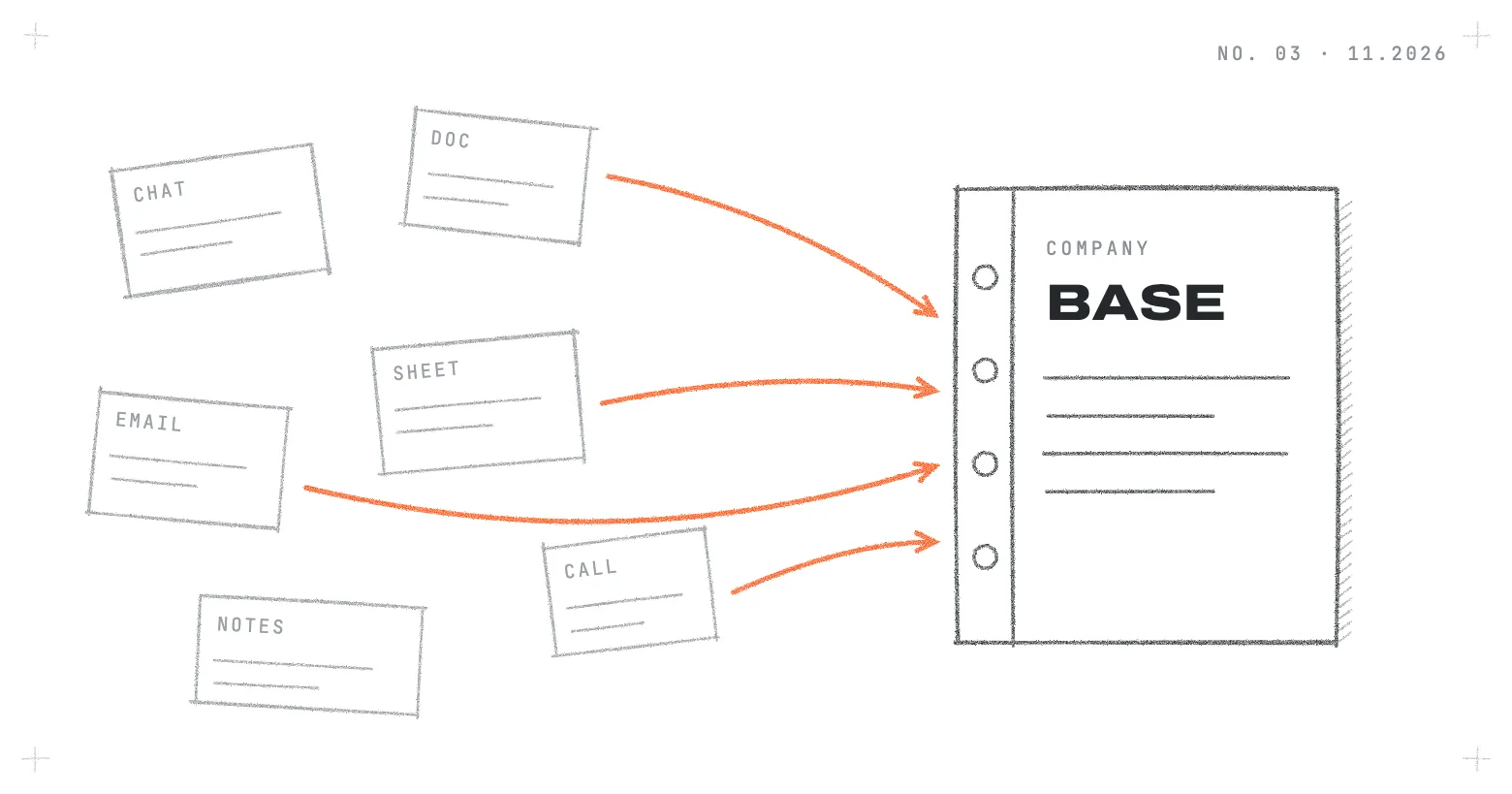
A new account manager asks how the discount for a returning client is calculated. One person knows, and that person is on vacation. The next day an AI assistant gets the same question. It does not ask around. It makes up a plausible answer. A company knowledge base exists so that both find the right answer in the same place.
Below: what goes into a company knowledge base, how to build one, how to write it so AI can use it, and how to keep it from going stale.
Why a company knowledge base matters now
Company knowledge sits in chats, documents and people's heads. The McKinsey Global Institute estimated in 2012 that knowledge workers spend about 19% of their workweek searching for and gathering information. In a 2018 Panopto survey, employees estimated that 42% of company knowledge is held by one person only. When that person leaves, the knowledge leaves too.
AI adds a second reason. A model knows the world in general and nothing about your company. Without a knowledge base, every request starts with retelling the context, or the answer stays generic. A shared base is what moves a team from the first stage of the AI maturity model, Prompt, to the second, Context. Skipping that stage is one of the common reasons AI projects fail.
What should a company knowledge base include?
A company knowledge base should hold what people keep asking each other every week: decisions with their reasons, agreements with clients, process descriptions, answers to recurring questions and project history. The test is simple. If only one person knows the answer, it belongs in the base.
- Decisions with reasons. "We only work with prepayment" says nothing useful when a long-standing client asks for an exception. The reason lets both a person and AI apply the rule to a new case.
- Client agreements. What was promised, on what terms, who is responsible on each side.
- Processes. How recurring work gets done: the steps, who owns what, what counts as done.
- Answers to frequent questions. Anything that has come up in chat three times.
- Project history. What was tried, what worked, what did not and why.
What stays out: passwords and keys (they need a separate vault), drafts with no conclusion, and copies of documents that live elsewhere. Link to the original. A copy turns into a second version of the truth within a month.
How do you build a company knowledge base?
Start with the questions your team asks most often and answer them in one place. Record every decision with its reason and date, keep one topic per page, and give each section an owner. Restrict what not everyone should see. From there, the base grows as part of daily work, a little every day.
- Start with questions. For one week, write down what people ask in chats and on calls. The answers to those questions are the first content of your base, and they are useful from day one.
- One place. If some rules live in Notion, some in Google Docs and some in email threads, neither people nor AI know which version to trust. Pick one place and link to it from the others.
- Date every decision. A date shows whether a rule still applies and makes it easy to spot pages nobody has opened in a long time.
- One topic per page. The title says which question the page answers. The first paragraph answers it, details follow.
- An owner for every section. A specific person who keeps that section true. "The base belongs to everyone" in practice means it belongs to no one.
- Access. Finance, salaries and personal data stay closed to people who do not need them, including any AI that talks to clients.
How do you write a knowledge base AI can use?
Write each page so it makes sense without the conversation it came from: full names instead of internal shorthand, explicit rules instead of hints, a date and a status on every page. A person who notices a gap will ask. AI fills the gap with a guess and presents it with the same confidence as a fact.
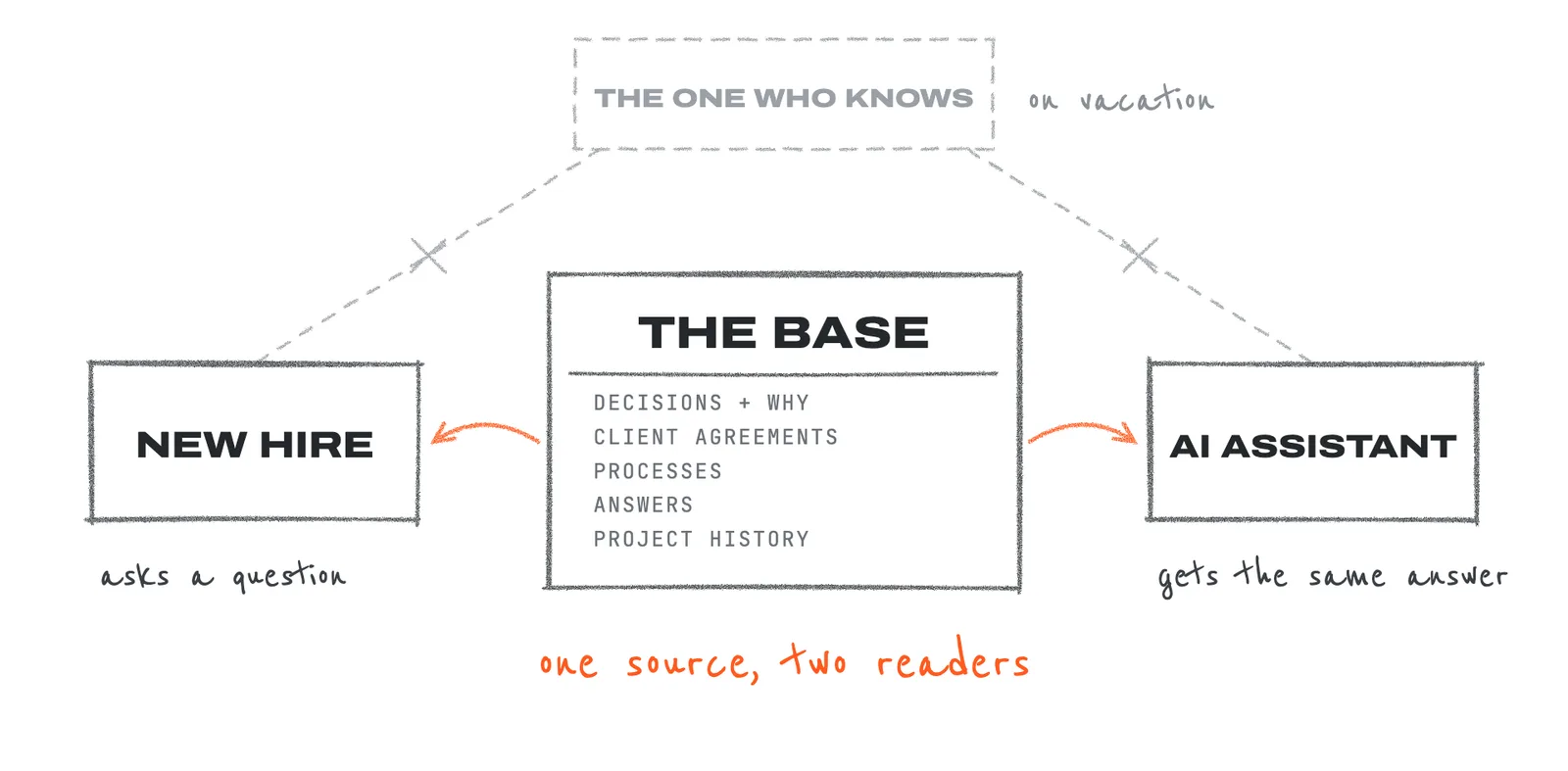
This is what separates a base written for two readers from a typical wiki, which is written for people and slowly stops being updated. The glossary covers the difference in more detail: AI knowledge base. Three habits make a base readable for a model:
- One meaning per word. If "client" and "customer" mean different things in your company, write down the difference.
- Remove contradictions right away. AI cannot tell which of two rules is newer and may pick either.
- An example next to each rule. Show how the rule looks on a real case.
How AI finds the right piece of the base for a task is covered under context engineering and RAG.
A simple readiness test: give AI five questions a new employee usually asks and have it answer from the base alone. Show the answers to a manager. Wherever the manager corrects something, that is where the base has a gap.
Which tool should you use for a company knowledge base?
The tool matters less than the habit of keeping the base current. Notion and Confluence work well when several teams share the base and need access rights. Obsidian keeps notes as files on your own machine, which suits teams that want everything in-house. What matters most is that AI reads the current version of the base, with no stale copies.
Whatever you choose, check three things:
- can AI read the base directly, without manual copy and paste;
- can you see who changed a page and when;
- can you restrict individual sections.
How to keep a company knowledge base up to date
A knowledge base goes stale when updating it becomes a separate task for later. What works is recording a change where it happens. A process changed in a meeting, so the base entry is part of the meeting. A client asked something new, so the answer goes into the base. AI helps here: after a task it suggests what is worth recording, and a person only approves.
We work this way ourselves every day, and the base pays off most when it grows in passing, as part of ordinary work.
5 signs your knowledge base works
- New people search the base first and ask colleagues second.
- A recurring question gets answered with a link to a page.
- AI answers questions about your company without context pasted into every request.
- There are never two versions of the same rule.
- When someone goes on vacation, the work does not wait for them.
If fewer than three of these are true, start with step one: collect the questions your team asks most often.
Summary
A company knowledge base answers the questions people ask each other every week, and it answers them the same way for a person and for AI. You build it from your team's questions, keep it in one place and update it as part of the work. Tools can change. The habit of recording each decision with its reason is what keeps the base useful.
To see which stage your team is at, take the short test in our article on the AI maturity model. If you want to see what a base for a team and AI looks like in a working system, we will show you on a 20-minute call.
Sources
- McKinsey Global Institute, "The social economy: Unlocking value and productivity through social technologies", 07.2012: https://www.mckinsey.com/~/media/McKinsey/Industries/Technology%20Media%20and%20Telecommunications/High%20Tech/Our%20Insights/The%20social%20economy/MGI_The_social_economy_Full_report.ashx
- Panopto, "Workplace Knowledge and Productivity Report", 2018, as reported by HR Dive: https://www.hrdive.com/news/inefficient-knowledge-sharing-costs-large-us-businesses-47m-a-year/527892/