
By Marko · 5 min read
Why Most AI Projects Fail (and the Stage Teams Skip)
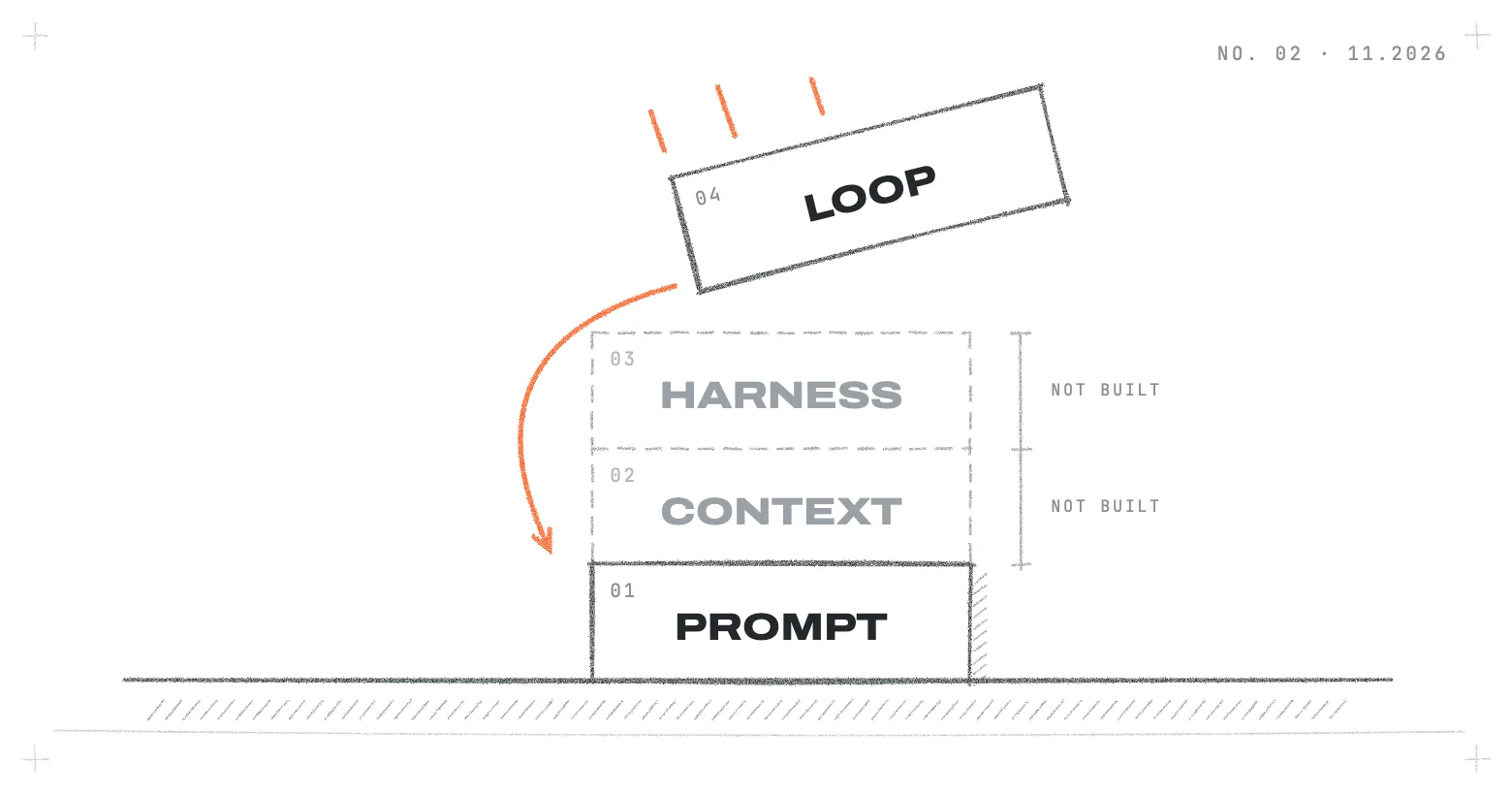
The demo works after one evening. The chatbot answers customers, the agent writes the report, the team is excited. Two months later the project quietly drops off the agenda. Sound familiar? That is how most AI projects end, and the model is rarely the reason.
Below: what the research says, where the famous 95% figure comes from, and the stage where projects actually break.
Why do most AI projects fail?
Most AI projects fail because teams jump to automation before AI knows the business context and before anyone agrees on what a good result looks like. The research keeps naming the same causes: a poorly defined problem, poor data, unclear value. The model is rarely the main problem. What it stands on is.
By estimates that RAND cites, more than 80% of AI projects fail, twice the rate of IT projects that do not involve AI. RAND researchers interviewed 65 experienced data scientists and engineers, and the first root cause they named was this one: the people asking for the project misunderstand, or fail to communicate, what problem AI is supposed to solve.
In 2024 Gartner predicted that at least 30% of generative AI projects would be abandoned after proof of concept by the end of 2025. The reasons it gave: poor data quality, inadequate risk controls, escalating costs and unclear business value.
Is it true that 95% of AI projects fail?
The 95% figure comes from MIT NANDA's 2025 report "The GenAI Divide", and it measures something narrower than it sounds. 95% of companies in the sample saw no measurable impact of generative AI on their profit and loss. It is a finding about one sample and about money. Applying it to every AI project in the world goes too far.
The MIT report is shared on request, so here we rely on Fortune's account of it. The wider picture matters too. Figures across sources range from 30% to 95% because they measure different things: abandoned pilots, projects that missed their goal, companies with no profit from AI. They agree on one point: failure is more common than success, and the causes are nearly always the same.
The reasons, stage by stage
In our article on the AI maturity model we described four stages: Prompt, Context, Harness and Loop. Each one rests on the one before. Put the causes from the research next to the stages, and nearly every cause turns out to be a stage the team skipped.
| Stage | What should be in place | How the failure sounds in research | The sign in your team |
|---|---|---|---|
| Prompt | shared rules for working with AI | our observation: the pilot depends on one person | results only for whoever started the pilot |
| Context | one knowledge base of the business | poor data quality (Gartner), not enough data (RAND) | AI has to be told every time who you are and how you work |
| Harness | a definition of "done" and a check | unclear value (Gartner), a misunderstood problem (RAND) | nobody can say whether the pilot worked |
| Loop | routine work that runs without manual reminders | escalating costs and unclear value (Gartner) | automation multiplies mistakes faster than anyone notices |
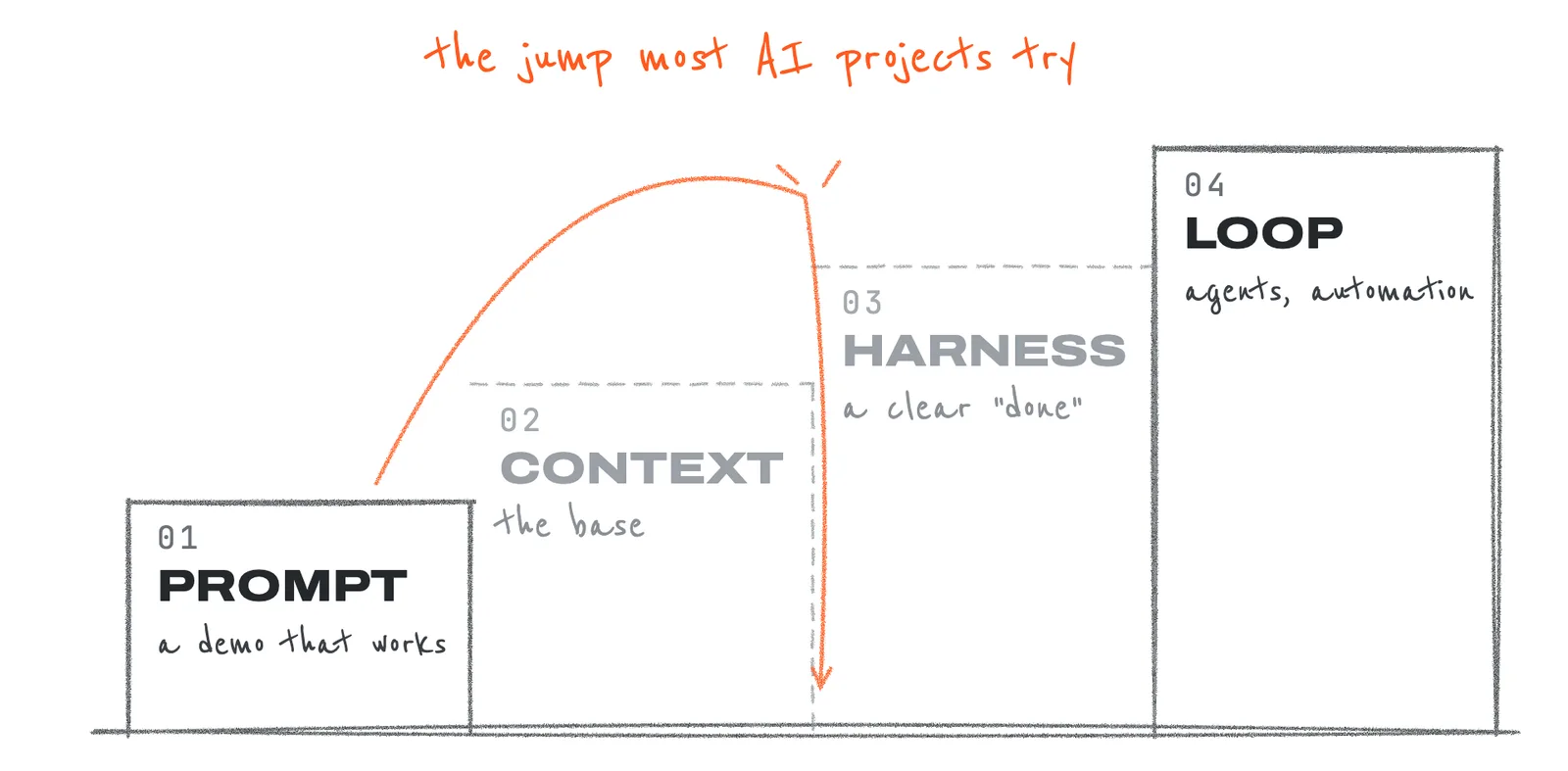
Context and Harness are the stages skipped most often. They are the least visible: no impressive demo, only written agreements and clear criteria. Yet they decide whether a pilot survives contact with real work. Context means an AI knowledge base your team and your AI both work from. Harness means every task has acceptance criteria and a result is checked against them.
Jumping straight to the fourth stage costs the most. Gartner predicts that over 40% of agentic AI projects will be canceled by the end of 2027. An agent without a knowledge base works blind, and an agent without a check on its results simply makes mistakes faster.
Why AI looks easier than it is
At the start, AI looks all-powerful. A prototype comes together in an evening, and right away people plan a few more systems, sometimes a product of their own. AI imitates simplicity: the first result shows up fast, and the real amount of work stays out of sight.
That work sits in the last stretch: gathering the context, building AI into the process, checking results, getting the team used to it. This is where projects stop, halfway, with a dozen half-built ideas.
We see this in our own work every day. Taking an AI project all the way is possible, and it takes a system that every next step can stand on.
How do you make an AI project succeed?
Start with one process. Write down the context AI will work from. Before you start, agree on what counts as a finished result, and check every result against it. Automate only what already works reliably by hand. That way the project moves through the stages in order, and none of them drops out.
Before you launch a pilot, answer five questions:
- Which one process are we changing, and who owns it?
- Where is the context AI will work from written down?
- How will we know a result is finished?
- Who checks a result, and how, before it is accepted?
- What has to work by hand before we automate it?
If even one question has no answer, the pilot risks becoming one more nice demo.
Summary
Most AI projects fail for the same reasons: teams jump to automation and skip the knowledge base and the check on results. The research gives different numbers and the same picture. The cheapest way to stay out of the statistics is to go through the stages in order.
To see which stage to start from, take the short test in our article on the AI maturity model. And if you want to see what the stages look like in a live system, we will show you in a 20-minute call.
Sources
- RAND Corporation, "The Root Causes of Failure for Artificial Intelligence Projects and How They Can Succeed", 13.08.2024: https://www.rand.org/pubs/research_reports/RRA2680-1.html
- Gartner, "Gartner Predicts 30% of Generative AI Projects Will Be Abandoned After Proof of Concept By End of 2025", 29.07.2024: https://www.gartner.com/en/newsroom/press-releases/2024-07-29-gartner-predicts-30-percent-of-generative-ai-projects-will-be-abandoned-after-proof-of-concept-by-end-of-2025
- Gartner, "Gartner Predicts Over 40% of Agentic AI Projects Will Be Canceled by End of 2027", 25.06.2025: https://www.gartner.com/en/newsroom/press-releases/2025-06-25-gartner-predicts-over-40-percent-of-agentic-ai-projects-will-be-canceled-by-end-of-2027
- Fortune, on MIT NANDA "The GenAI Divide", 18.08.2025: https://fortune.com/2025/08/18/mit-report-95-percent-generative-ai-pilots-at-companies-failing-cfo/